The Headache That Starts At The Base Of Your Skull Isn’t Coming From Your Head. Physical Therapists Say It’s Your Neck Curve Collapsing.
Why the stiff neck you wake up with, the headache by mid-afternoon and the 3 a.m. waking are one problem, why pills and new pillows don’t reach it, and the 15-minute routine clinics use to put the curve back.

If you are over 50, there is a good chance you know this headache. It doesn’t start at your temples. It starts at the back, right where your skull meets your neck, and by the afternoon it has crept up over the top of your head and settled behind your eyes.
You probably wake up with your neck stiff, too. Turning to check your blind spot hurts. You may wake at 3 a.m. with one arm numb. And you have probably been told, or told yourself, that it is stress, or your age, or your pillow.
Physical therapists say it is none of those. They say it is the shape of your neck.

A headache that comes from the neck
Doctors have a name for a headache that starts in the neck: a cervicogenic headache. It is far more common than most people realize, and it is routinely mistaken for a tension headache or a migraine, which is why the usual treatments for those barely touch it.

“Most of the patients I see with daily headaches over the age of fifty have the same X-ray. The neck has gone straight. Fix the neck and the headaches usually go with it.”
What a collapsed neck curve does
A healthy neck curves gently forward, in a shallow C. That curve is what lets the weight of your head, about eleven pounds, sit balanced on top of your spine.
Decades of looking down, at books, at sewing, at the kitchen counter and now at phones, slowly pull that curve flat. Doctors call a neck that has gone straight “military neck.” Dr. Matthews calls it a collapsed neck curve, and she says she sees it on most of the X-rays that come across his desk from patients over fifty.

When the curve collapses, your head slides forward. And every inch it moves forward adds roughly ten pounds of load on the muscles at the back of your neck, according to a widely cited study in Surgical Technology International. Three inches forward, which is common, and those muscles are holding up the equivalent of a 40-pound head, all day long.
The effective weight your neck muscles carry as your head moves from upright to tipped forward. They never get a break, even in bed, if your pillow holds your neck flat.
Muscles that work that hard for that long do one thing: they knot up. The worst of it collects in the small suboccipital muscles at the very base of your skull. Those knots press on the occipital nerves that run up the back of your head. That pressure is the headache. The same tight muscles are why your neck is locked in the morning, why you can’t turn to reverse the car, and why lying flat at night leaves an arm tingling.
Why pills, massage and new pillows don’t fix it

Painkillers dull the headache for a few hours. The neck is still straight and the muscles are still knotted when they wear off.
Massage and adjustments loosen things for a day or two. “Then the patient goes home, looks down at their phone for six hours, and the muscles pull the neck straight again,” Dr. Matthews says.
Memory foam pillows hold your head where it already is. If your neck has gone straight, a pillow that cradles it holds it straight.
Try this: the 20-second wall test
- Stand with your heels, backside and shoulders against a wall.
- Without tipping your chin up, try to touch the back of your head to the wall.
- If your head doesn’t reach the wall, or only reaches it when you tilt your chin up, your head is sitting forward of your shoulders. That is the most common sign of a collapsed neck curve.

What physical therapists actually use
In the clinic, the standard treatment is cervical traction: the patient lies on their back while a curved support gently lifts and lengthens the neck back toward its natural curve. It is usually paired with heat to relax the muscles first, and soft-tissue work on the knots.
“Traction is the part that changes the shape. Heat and massage make the muscles let go so the traction can work. The trouble is it has to be daily, and nobody can come to a clinic every day.”
That is where a newer kind of device comes in. Instead of a clinic visit or a door-mounted harness, it puts all three into a pillow you lie back on at home.
The 3-in-1 pillow readers keep asking about
The one we hear about most is the Cervana. It looks like a contoured pillow, but it works like the treatment table. The raised center roll lifts and stretches the neck into its curve. Heat pads built into the roll warm the muscles at the base of the skull. And four gentle vibration patterns work into the knots. Fifteen minutes on your back, on the bed or the sofa, and it switches itself off.

“It is not magic and it is not a clinic,” Dr. Matthews says. “But it does the three things a clinic would do, and you can do it every night. Every night is the part that matters.”
What readers report
We asked readers who had used one for a month what changed. The same three things came up again and again:
- Waking up loose instead of locked. Most noticed it within the first week.
- Fewer afternoon headaches. Several said they had stopped reaching for painkillers by week two.
- Turning their head again. Checking the blind spot, looking up at a shelf, looking round at a grandchild.

| Painkillers | Chiropractor | Foam pillow | Cervana | |
|---|---|---|---|---|
| Treats the neck curve | No | Wears off | No | Yes |
| Releases the knots | No | For a day | No | Heat + vibration |
| Every day at home | Yes | No | Yes | 15 minutes |
| Ongoing cost | Monthly | $60+ a visit | None | One payment |
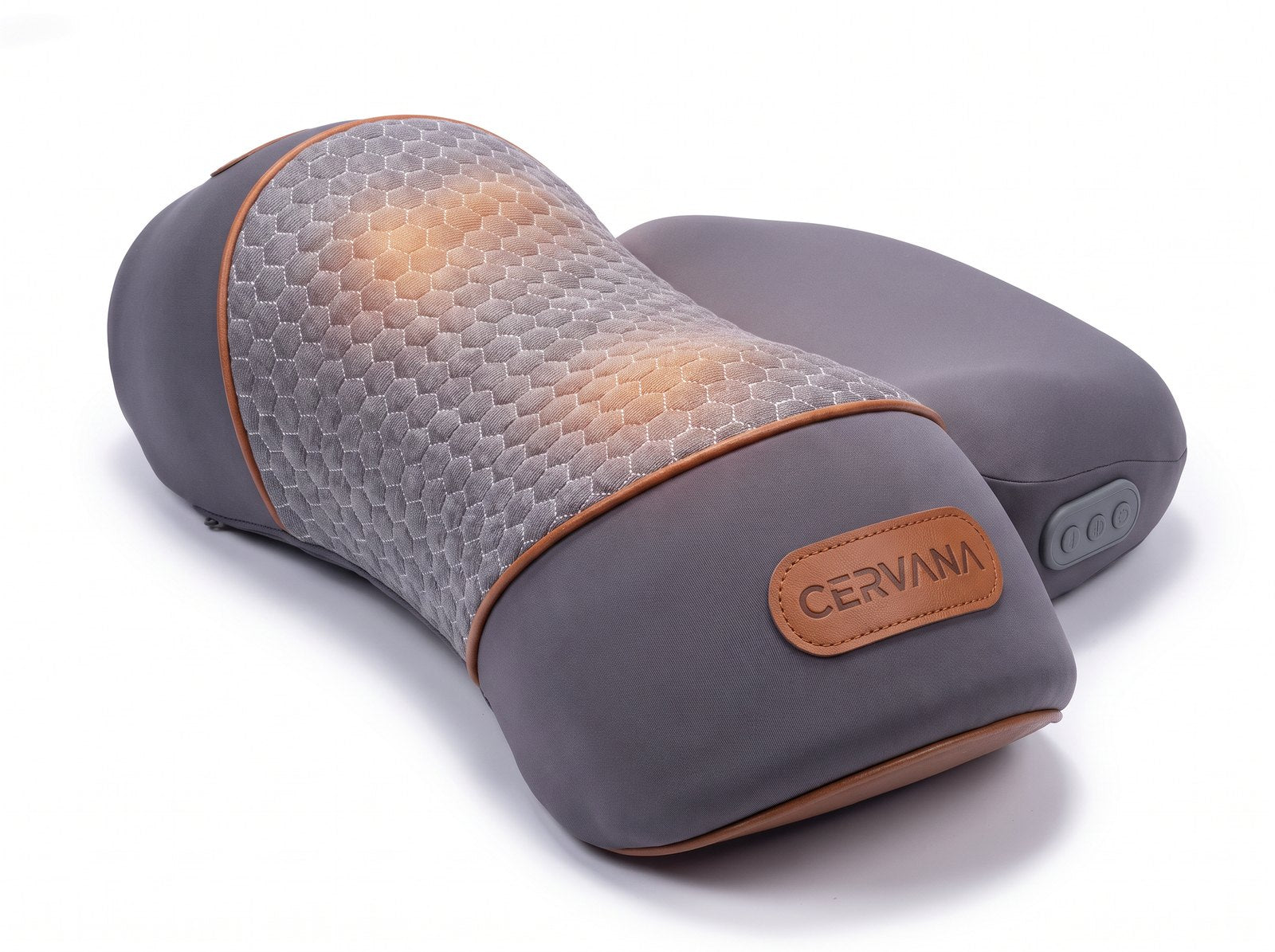
- Restores support to your neck’s natural curve — the center roll lifts and lengthens it
- Releases the knots at the base of your skull — soothing heat and four vibration patterns
- Fifteen minutes a night — on the bed or sofa, with auto shut-off
- Cordless and rechargeable — several sessions per charge
$368.00 $184.00 today
Money-back guarantee · Free US shipping

Did the wall test in my hallway and my head was nowhere near it. Explains a lot. Using the pillow two weeks now and the headaches are way down.

Thirty years at a drafting table. I can look over my shoulder in the truck again. Wish I’d read this ten years ago.

The heat right at the base of the skull is exactly where my headaches start. Fifteen minutes and it’s like a knot untied.
Cervana is sold direct, not in stores or on Amazon. After this report first ran it sold out twice. It is back in stock with the sale price showing on their page today, but stock is limited.
Check Today’s Price & Stock →This article is for general information. Individual experiences vary.
Hansraj K.K. (2014). Assessment of stresses in the cervical spine caused by posture and position of the head. Surgical Technology International 25.
Bogduk N., Govind J. (2009). Cervicogenic headache: an assessment of the evidence on clinical diagnosis, invasive tests, and treatment. The Lancet Neurology 8(10).