“Every Doctor You’ve Seen Has Been Treating Your Prostate Wrong. Here’s What They Should Have Told You.”
If you’ve been told your night-time trips are “just your prostate,” or you’ve spent years on saw palmetto and pills that did nothing — read this before you spend another dollar.


What I’m about to tell you might cost me my reputation.
I don’t care. Someone needs to say it.
My name is Dr. Alan Whitaker. I’m a urologist. Twenty-two years spent on the male urinary tract and nothing else. More than 4,000 men treated.
- Enlarged prostate (BPH)
- Night-time urination
- Urgency and weak stream
- Overactive bladder
I have spent my entire career on one question: why men stop sleeping through the night, and how to make it stop.
And I am tired of watching my own profession fail the men who need us most.
Let me guess what happened to you.
You went to your doctor. He did the exam. Maybe he drew a PSA. He told you your prostate is enlarged and that it is normal at your age — and he said it as though that was supposed to be a comfort.
Then he wrote you a prescription for tamsulosin. Maybe the stream improved a little. And something else got worse: the light-headedness when you stand up too fast, and the thing almost no man raises at the follow-up appointment. Roughly one man in seven on that drug loses his ejaculation entirely.
So maybe you went further. Finasteride. And you read what it does to some men before you filled it, and you decided a slightly better stream was not worth that trade.
Or maybe you did what most men do. You went to the pharmacy and bought a bottle of saw palmetto. You took it faithfully for three months. Nothing changed. And you quietly concluded that supplements are junk and this is simply what getting old looks like.
Maybe you stopped drinking anything after six o’clock. And you are still up three times.
And then there is the part you have not told anyone.
You have started planning your life around it. Where the bathroom is. The aisle seat. Whether the drive is too long. Whether the trip is worth the bother at all. You have moved into the spare room so your wife can sleep — or she has stopped sleeping too.
And somewhere at the back of your mind, you have started wondering how much further this goes. Whether the next conversation is about a camera, or a catheter, or an operating table.
If any of that sounds like your life, read the next four hundred words carefully.
You are not simply getting old. And in almost every man I see, the size of your prostate is not what is waking you up.
You were given the wrong explanation for what is happening inside your body. Today I am going to give you the right one.
It’s Not the Size of Your Prostate. It’s Bladder Static.
Every doctor you have ever seen told you the same story. The prostate grows. It wraps the urethra and squeezes it like a hand on a garden hose. Less gets through, so you go more often.
They are not completely wrong. But they are missing the piece that matters most.
Here is the fact that should have ended that story forty years ago:
The size of a man’s prostate barely predicts his symptoms at all.
I have examined men whose prostate is the size of a lemon and who sleep eight hours without stirring. And I have sat across from men whose gland is barely enlarged who are up five times a night. If the gland were the cause, that could not happen. In my clinic it happens every week.
There is a second clue, and it comes from the controlled research on rye pollen extract. Men taking it got up significantly less at night than men on placebo — while their prostate size and their flow rate did not change at all.1
Read that again. The nights got better. The gland did not.
So what was waking them up?
The answer was never in the prostate. It is in the wall of the bladder.
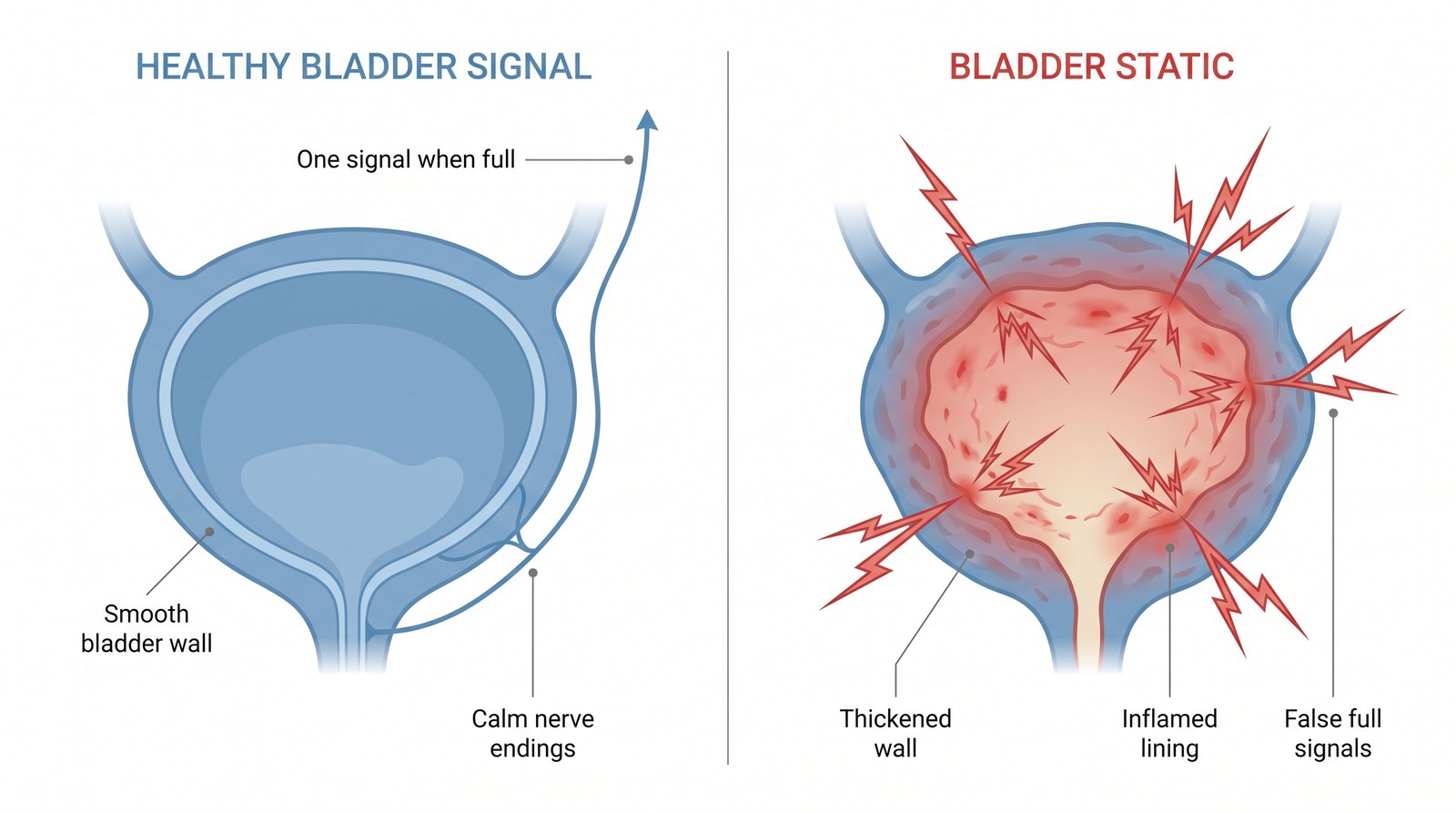
The bladder fills. The nerves woven through its lining stay quiet until it is genuinely full, then send one clear message to the brain. You sleep through the night and empty it in the morning.
The wall has thickened from years of pushing, and the lining is chronically inflamed. The irritated nerves fire “full” at a fifth of capacity — at midnight, at 2am, at 4am. Every one of those messages is false, and your brain has no way to tell.
Your bladder is a muscle with a nerve network woven through its lining. After years of pushing against even mild resistance, two things happen to it. The muscle thickens — the way any muscle thickens under load. And the lining stays quietly, chronically inflamed.
Inflamed tissue does one thing above all others. It makes nerve endings irritable.
An irritated nerve does not wait for a full bladder. It fires when you roll over. It fires at two in the morning when there are barely two ounces in there. And your brain cannot tell a true signal from a false one, so it does exactly what it is supposed to do. It wakes you up.
You walk to the bathroom. You stand there. You pass almost nothing. You go back to bed — and ninety minutes later the same false alarm goes off again.
I call it Bladder Static: the line between your bladder and your brain, full of noise.
This Is Why Nothing You’ve Tried Has Worked
Now look at what every one of those treatments has in common.
Saw palmetto is aimed at the gland. Finasteride shrinks the gland. Tamsulosin relaxes the muscle at the neck of the gland. Surgery removes part of the gland.
Every single one of them is treating the hose. Not one of them touches the wire.
That is not a small oversight. It is the reason a man can have a technically perfect procedure, walk out with the stream of a thirty-year-old, and still be up three times that night. I have had that conversation more times than I can count and I have never once enjoyed it.
And it is the reason your saw palmetto did nothing. It was never junk. It was pointed at the wrong target — and on its own, at a drugstore dose, it was pointed there weakly.
If noise on the line is the problem, then the only thing that will ever help you is something that quiets the line.
What Actually Quiets It
You do not calm an irritated nerve by shrinking a gland. You calm it by calming the tissue the nerve is sitting in.
That is a completely different job, and it needs completely different compounds — the ones that go after low-grade inflammation in soft tissue, at doses high enough to matter, taken long enough to matter.
For four years I put my own patients on a combination I assembled myself out of a pharmacy and a supplement catalogue. It was inconvenient, it was expensive, and it worked well enough that men kept coming back to tell me about it. Not about their stream. About their sleep.
Eventually I stopped writing the list out by hand and had it made properly — in one bottle, at the doses I actually wanted.
Introducing Mantle FlowReset

Two capsules each morning. Ten botanicals. And unlike every prostate supplement on the shelf behind your pharmacist, the two largest doses in it are not aimed at your prostate at all.
They are aimed at the static.
Quercetin
The plant compound with the most human research behind it for chronic prostate and pelvic inflammation. It sits at the front of this formula, at a real dose, because calming the irritated tissue around those nerve endings is the entire point of the bottle. Almost nobody in this category leads with it. That is exactly why they keep failing men like you.
Curcumin
Curcumin works a different inflammatory pathway from quercetin, which is why the two belong together rather than apart. The turmeric in your spice rack will not do this — the amount you would have to eat is absurd. This is the concentrated root extract, at a dose you can actually feel.
Saw Palmetto and Beta-Sitosterol
The traditional answer to a restricted stream, and they do belong in the bottle — just not at the front of it. Beta-sitosterol has the strongest evidence in the whole category for urinary symptom scores and flow measures. On their own they were never going to fix your nights. Underneath the two compounds above, they finish the job.
Rye Pollen and Pygeum
Rye pollen extract is the ingredient from the trial I mentioned earlier — the one that cut men’s night-time trips without changing the gland at all. It is the clearest evidence there is that the bladder, not the prostate, is what wakes a man up. Pygeum bark sits beside it as the traditional African remedy for exactly this complaint.
Pumpkin Seed, Grape Seed, Pine Bark and Lycopene
The antioxidant layer. Inflammation is not a single event — it is a cycle that feeds itself — and these four are here to interrupt it, protecting the tissue between doses so the calm you build in month one is still there in month four.
Ten ingredients. No proprietary blend hiding the doses. Two capsules with breakfast, and nothing else to remember.
And I want to be straight with you about how fast this moves, because it surprised me too. Inflamed tissue settles far quicker than cartilage or bone ever does. Most men notice a difference inside the first week, and by the end of the second week the change is not subtle — it is two or three fewer trips a night, and the first uninterrupted sleep they have had in years. It keeps building from there, which is the only reason I push the larger packages at all.
Don’t Take My Word for It. Look at What Happened to My Patient Ray.
Ray is 67. He came to me having already done everything in the right order.
Exam, PSA, ultrasound. Enlarged, but not dramatically. Two years on tamsulosin, which he stopped himself because of what it did to him. Eight months of saw palmetto from the pharmacy. He had cut out coffee, cut out beer, and stopped drinking water after five in the afternoon.
He was up four times a night. He had been up four times a night for six years. He was sleeping in the spare room so his wife could get through to morning, and he told me — I remember exactly how he said it — that he had “made peace with it.”
I asked him to stop trying to fix his prostate for ninety days, and to fix the inflammation instead.
He rang the clinic on day nine. He was down from four trips to two, and he wanted to know whether that was supposed to happen that fast. By the end of the second week he was up once. At the three-week visit he told me he had slept from eleven until half past five, straight through, for the first time since his sixtieth birthday — and then he sat in my office and could not speak for a moment.
His prostate, for what it is worth, was exactly the same size it had been in March.
That is the entire point.
Thousands of Men Are Now Doing the Same Thing
Ray is not unusual. He is typical. Here is what men have written in since:
I stopped counting at two
“I was up four and five times, every night, for years. I am now at one, and some nights none at all. I did not believe the explanation when I read it. I believe it now.”

My wife noticed before I did
“She said “you did not get up last night.” I had not. I had slept the whole way through and had not even registered it. Six weeks in.”

Nothing else touched it
“Saw palmetto for a year, the prescription for eight months, gave both away. This is the only thing that has changed a single night for me.”

I can sit through a film again
“The nights were the reason I bought it. The days were the surprise. I am not hunting for the bathroom the second I walk into a building any more.”

Now, I Know You Have Two Questions
“Is it safe, and will it interact with what I already take?”
It is a food supplement made of botanicals and there is no drug in it. Most men take it alongside everything else on the kitchen counter without a second thought. Two exceptions I want you to hear: if you take a blood thinner, or medication for blood pressure or diabetes, show this page to your pharmacist before you start. That is not a legal hedge. Quercetin and curcumin are genuinely active compounds — which is the reason they work, and the reason that two-minute conversation is worth having.
“How long before I know?”
Faster than you are expecting. Most men feel the first change inside a week, and by the end of the second week it is a big one — several fewer trips a night rather than one. It keeps improving for months after that, which is why the larger packages are discounted so heavily: the men who get their nights back permanently are the ones who stayed on it.
We Could Sell Out Tomorrow. Or Today.
I need to be straight with you about supply, because I would rather you were annoyed with me now than disappointed in a week.
Quercetin and curcumin at these doses are not cheap, and the rye pollen extract comes from a small number of growers. We batch what we can source. When a batch goes, it goes — and the last one went in eleven days.
If the page below is still taking orders when you reach it, the batch is still open. That is genuinely all I can promise you.
FlowReset Is Not Available on Amazon or in Stores
And it will not be.
Two reasons. The first is money: shelf space and marketplace fees would take roughly a third of the price, and the only place to find that third is inside the bottle. I would have to cut the quercetin. I am not doing that.
The second is that I want to know who is taking it. Every bottle ships direct, which means that if it does not work for you, you are talking to us — not to a marketplace seller in another country.
Right Now, On This Page Only: Up to 60% Off
A single bottle is the most expensive way to buy it, and one month is not where this ends — the men with the biggest changes are the ones still taking it in month three.
The three- and six-bottle packages bring it down to a little over a dollar a day, with free shipping in the United States. The six-bottle package is what I put my own patients on — it takes the decision off the table for six months, and the per-bottle price never gets better than that.
365 Days to Try It. You Can Even Keep the Bottles.
Take it for a month. Take it for six. If your nights are not measurably better, write to us and we refund the entire order — and we will not ask you to post anything back.
I can offer that because I know what the three-month number looks like. The men who ask for a refund are almost always the men who took it for nine days.
Here’s What to Do Right Now
Click the button below. It will take you to the page where you choose your package.
Take the six-bottle package if you can and the three if you cannot. Then take two capsules with breakfast and change nothing else about your life for two weeks — no cutting fluids, no bathroom schedule, nothing. I want you to be able to tell what is doing the work.
Then count your trips.
There Is Zero Risk. Except the Risk of Doing Nothing.
Here is what I know from twenty-two years of this: it does not stay where it is.
The bladder wall does not un-thicken on its own. The inflammation does not resolve because you have decided to ignore it. Men who are up twice at sixty-two are up four times at sixty-eight — and the men who are up four times are the ones falling on the way to the bathroom at two in the morning, which is not a small thing at all. Over sixty-five, two or more night trips carries more than double the rate of fractures.2
You have already spent years and real money treating the wrong thing. I am asking for two weeks on the right one.
Comments (34)
71 years old and I have not slept through a night in a decade. Three weeks in and I am down to one trip. I will take it.
My doctor never once mentioned the bladder wall to me. Not once in nine years. Reading this made me angry more than anything else.
I bought it for my husband because I have not had a full night either. He is on week five. Now I have.
Does anyone know if this is alright alongside a blood pressure tablet?
Ken — most men are fine, but show the ingredient list to your pharmacist first. It takes two minutes and it is the right call.
Ordered the six pack after reading the part about buying one bottle to test it. He is right, that is exactly what I did last time with something else and I gave up in a fortnight.
Sceptical. I have been sold prostate miracles before. But the bit about the pollen study not changing prostate size is checkable, and it checks out, so I am in for three months.
Week nine. Two trips down to zero or one. My wife has moved back into the bedroom, which I did not expect to be the outcome of a supplement.
Is this the same as the saw palmetto I already buy him at the pharmacy?
Elaine — no. Saw palmetto is in it, but it is a minor part. The two biggest doses are quercetin and curcumin, and that is the whole difference.