
“For 19 Years I Made The Drug Hospitals Use To Save A Poisoned Liver. Not Once Did Anyone Tell People They Could Take It Every Day.”
If your doctor told you to cut back on the drinking and come back for another blood test in three months, this is what those three months are for. Nobody tells you. I only worked it out when it was my blood test.


I did this several hundred times and never once stopped to think about it properly.
For nineteen years I worked in a hospital pharmacy. On a bad night, someone comes in having taken far too much paracetamol. Paracetamol in a big enough dose poisons your liver. There is one treatment for it, and it has been the treatment since the 1960s: a drip of a compound called NAC.
I made up that drip. It went upstairs. It worked. People who would have lost their liver kept it.
Then I turned fifty-one, had a routine blood test, and got a phone call telling me one of my liver numbers was too high.
I want to be careful, because there is a cheap version of this article and I am not writing it. I am not going to tell you that a supplement fixed a blood test, and I am not going to tell you what your numbers mean. I do not know your numbers and I am not your doctor.
What I can tell you is what I actually handled, for nineteen years:
- Intravenous N-acetyl-cysteine for acetaminophen toxicity, on the standard protocol
- Ward stock for respiratory use, where the same compound has been used for decades
- The oral powder, and every complaint anyone ever made about it
- Discharge counselling for people going home with a liver they had frightened
So here is the question I had never once asked, in nineteen years of hanging that bag.
The reason the infusion works is not complicated. Acetaminophen becomes NAPQI, NAPQI is toxic to liver cells, and the body neutralises it with glutathione. In an overdose the glutathione runs out. The infusion supplies the raw material to make more of it, fast, and the liver does the rest.
It is a refill. That is all it has ever been.
And it never occurred to me — not once, in nineteen years — to ask what the slow version of running out looks like in somebody who is not in an emergency department. Somebody who just drinks on weekends and is fifty.
Let Me Guess What Happened To You
You had a blood test you were not worried about. Something routine — an insurance medical, a check-up, a new prescription that needed baseline bloods.
A few days later somebody said the word elevated. One line on the sheet, flagged. ALT, probably. Maybe AST alongside it. Not dramatically high. Not nothing.
And the advice was some version of: cut back on the drinking, lose a bit of weight if there is any to lose, and we will retest in three months.
Which is correct advice. It is also entirely a list of things to stop. You walked out of there with nothing to start, and if you are honest, the cutting back lasted about a fortnight.
You were not lazy about it. You did roughly what you were told.
Nobody gave you anything to do with the three months, because the consultation is built around the retest and not around the interval. The interval is where the whole thing is actually decided, and it is the part nobody owns.
It Is Rust. Slow, Chemical, Unspectacular — And It Has A Studied Dose.
Your liver is rusting. Not as a figure of speech — as chemistry. Every drink, every painkiller, every takeaway gets broken down by your liver, and that process oxidises the tissue doing the work. Oxidising is rusting. It is the same reaction that eats through a gate, happening inside an organ. One thing stops it: an antioxidant called glutathione. Anti-oxidant. Anti-rust. Your body makes it fresh every day and cannot store it — and after thirty you make about ten percent less of it every decade. So the rust does not stop. There is just less and less standing in front of it.
We called it liver rust in the end, because that is honestly what it is. Not an injury, not an infection, nothing you would catch on a scan for years — a slow oxidation of the tissue that does the work, held off by an antioxidant that is running short. Rust with nothing in front of it.


This is the part that embarrassed me, because I am a pharmacist and I should have joined it up years earlier.
Everyone who has tried oral NAC powder knows about the burps. Rotten eggs, an hour after the dose, and it is the single most common reason people quit inside a week. For years I filed it as an unpleasant side effect.
It is not a side effect. It is a failure report. Dry NAC degrades in stomach acid; the fraction that does not absorb travels on to the large intestine, where bacteria reduce it to hydrogen sulfide. If you can smell it, a meaningful part of that dose never reached your bloodstream. People were not tolerating a nuisance. They were paying for a delivery that failed and being handed the receipt in the most humiliating way available.
An oil-filled softgel changes that arithmetic, which is why the version worth taking is suspended in coconut and MCT oil rather than pressed dry into a capsule.
“We spent two decades perfecting the emergency dose. Nobody in that building was working on what the same compound should look like on a Tuesday, for somebody who is not dying.”
Dean Hollis, hospital pharmacist, 19 years
Go And Look At The Salt In Your Dishwasher
Not now — when you finish reading. There is a cap in the base of the machine, under the bottom rack, and it holds a coarse salt that has nothing to do with the detergent.
When it runs low, the machine does not stop. No light comes on for a while. Nothing breaks. The glasses simply start coming out faintly cloudy, and everyone in the house blames the detergent, or the water, or the age of the machine.
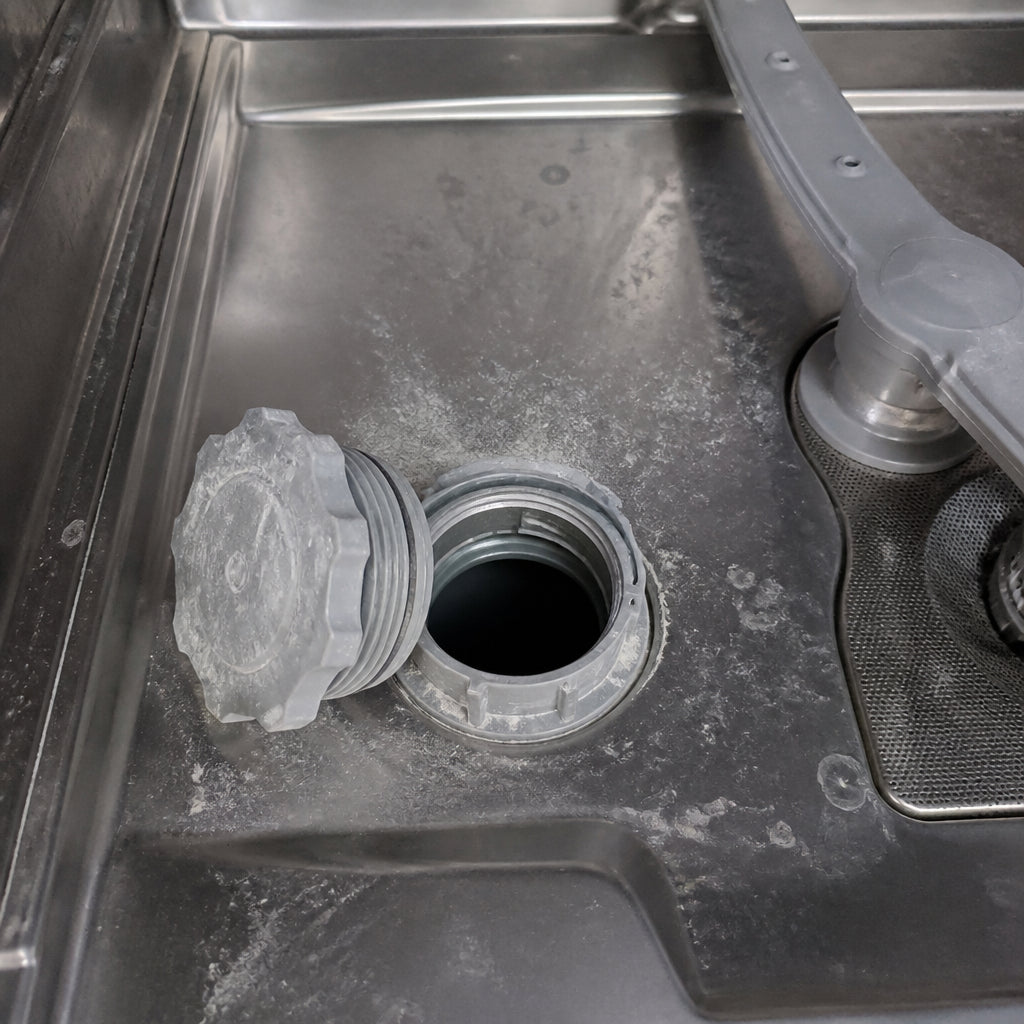
So: is the dishwasher broken? No. Would a better detergent fix it? No — and that is the bit people spend money on. Would a newer machine fix it? No.
The machine is fine. A consumable ran out, and because it ran out slowly, the first thing anybody noticed was the cloudy glass rather than the empty compartment.
That is the shape of this. The liver is not broken. Something it spends every single day is arriving slower than it is being used, and the first thing anybody notices is a Saturday that does not start, or a number on a blood test, which are both results and neither of which is the cause.
Nobody Gets Worried All At Once
This is the part that made me write something instead of retiring quietly.
People do not go from fine to frightened in one step. It happens as a series of small accommodations, each of which is entirely reasonable on its own:
- The second glass on a weeknight, quietly dropped, without ever deciding to
- The Sunday that is now a write-off, planned around rather than mentioned
- The three o'clock wall, blamed on the coffee, then on the sleep, then on the age
- The blood test result you did not mention to anyone
- The retest you have moved twice
Not one of those is worth phoning a doctor about. Which is exactly why it runs for a decade.
And the cruel part is that the interval where it could be different — the three months between the flagged test and the retest — is the one stretch where somebody is actually paying attention, and it is the stretch nobody is given anything to do with.
So What Would I Actually Do?
I would stop looking for a herb that protects the liver and start supplying the thing the liver spends.
The dose is not a matter of opinion. A 2010 trial published in Hepatitis Monthly gave patients with non-alcoholic fatty liver disease NAC at 600 mg every twelve hours for three months, and reported a statistically significant reduction in ALT against a vitamin C control. Six hundred milligrams, twice daily, three months — that is the studied shape, and it is the shape the product I take is built around.
N-Acetyl-L-Cysteine
The raw material your body converts into glutathione. Not the antioxidant itself — the thing it is built from, which is the part your stomach can actually absorb. Swallowing glutathione directly does not work; stomach acid breaks the molecule before it reaches your bloodstream.
NAD+
Nicotinamide adenine dinucleotide sits in the reaction that turns what you eat into usable cellular energy. It is in the formula because the complaint underneath most of this is not a blood number, it is the four o'clock wall.
Coconut & MCT oil
The reason there are no sulfur burps. Dry NAC powder degrades in stomach acid and what does not absorb reaches the large intestine, where gut bacteria turn it into hydrogen sulfide. An oil-filled softgel carries it through.
That is Mantle NAC600. It is not a cleanse and it does not pretend to be one. It is 600 mg of the same compound I hung in a bag for nineteen years, at a daily dose instead of an emergency one, in an oil softgel so that it arrives.
A daily 600 mg softgel is not an emergency intervention and nothing here is a reason to change how you take a painkiller. It is daily support for the same system the hospital tops up all at once.
What I will say, as plainly as I can: if you have three months and a number you would like to be different at the end of them, spending the interval doing nothing is a choice, and it is the one almost everybody makes.
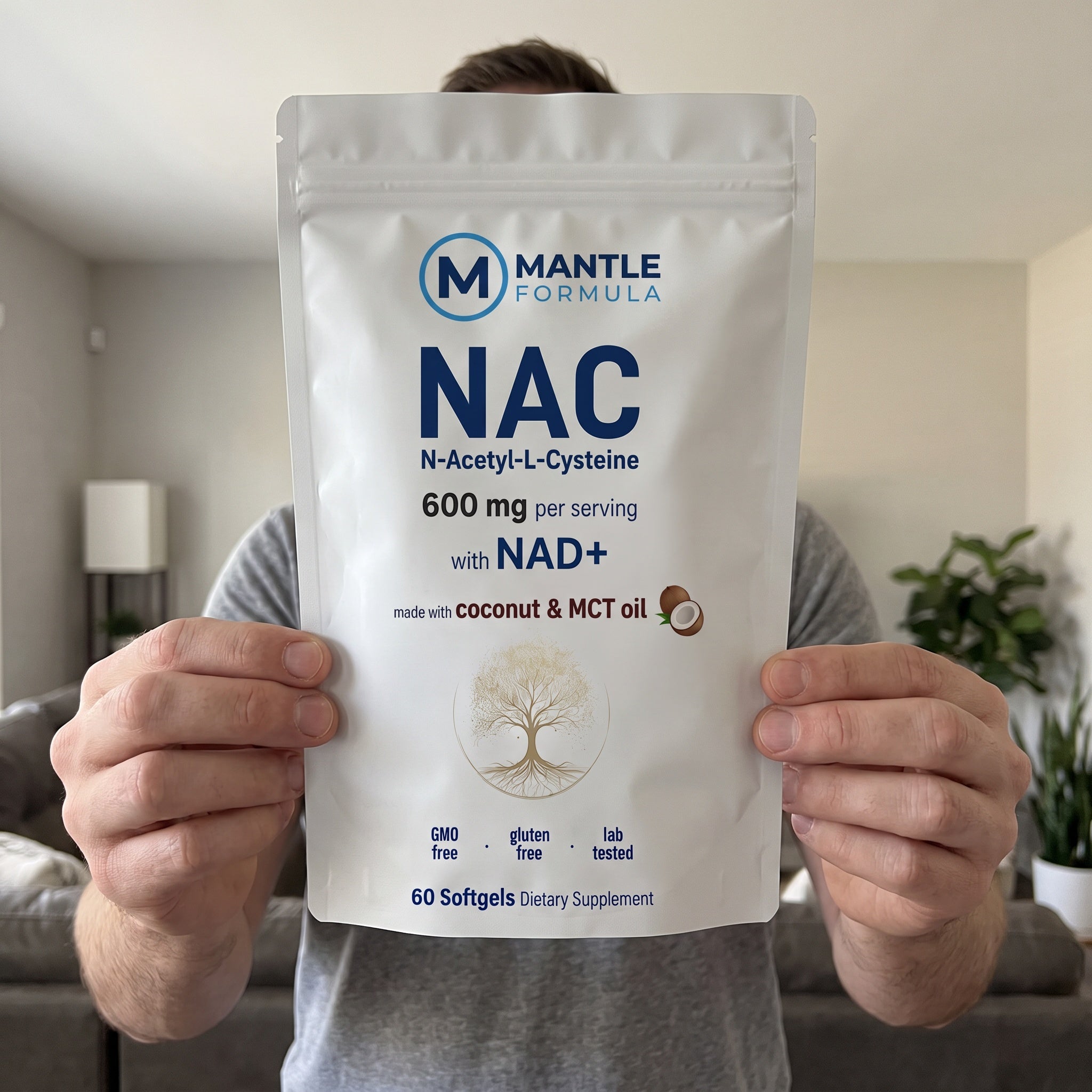
If you have a retest in the calendar, you already know what this article is about. You have a window, and it is currently doing nothing.
Use it or spend it. Those are genuinely the options.