My Daughter Was Right That I’d Stopped Going Out. She Was Wrong About Why.

August 26, 2026
I went down in a grocery store parking lot on a Thursday morning. Fourteen months later I climbed two hundred and fifty-seven steps to the top of a lighthouse, on my own, three hundred miles from home. Nobody who decided what I could and could not do had thought to ask me first.

Two hundred and fifty-seven steps. My name on the reservation and nobody else’s.
The Thursday Outside The Grocery Store
I went down in the parking lot on a Thursday morning. Groceries all over the asphalt.
Two young men helped me up. Neither of them said anything. They just looked at me, the way you look at something that has broken.
I told them I was fine, because I was. Nothing was hurt except the eggs.
What I could not do was get up on my own. Twenty-nine years a home health nurse and I had gotten other people up off floors for a living. Hundreds of them. I knew every way there is to do it.
I could not do a single one of them for myself.

The Sentence I Heard Through The Kitchen Door
That night my daughter Nicole said, “Mom, I don’t think you should be driving into town on your own anymore.”
She said it kindly. That is the part people get wrong about this. Nobody is cruel. Everybody is kind, and the kindness is what does it.
Later I heard my son-in-law on the phone in the kitchen. He did not know I was standing in the hall.
“She’s not safe on her own anymore.”
I did not argue with him. I stood there and I decided that he was going to be wrong.
Nobody Takes It Away All At Once
Nicole started doing my shopping on Wednesdays. She never asked whether I wanted to come.
I stopped going to my grandson’s Christmas concert, because the school gym is up a flight.
I stopped going to Christmas at theirs, because the only bathroom is upstairs. I stopped going to the New Year’s party at the Legion.
Not once, in three years. And I always had a reason ready before anybody asked. That is the part I would like people to hear. By the end I was turning things down before the invitation came, so that nobody would ever have to watch me work out whether I could manage it.
There is a drawer in my kitchen with eleven braces and sleeves in it. Neoprene ones. A hinged one that cost sixty dollars. Two that came in the mail after I saw them on television. Untouched for two years, every one of them.
The orthopedist had used the words wear and tear, and told me to expect it at my age, and said it the way you say something that is meant to be a comfort.

The Question Jean Asked Me
Then Jean came over. She is seventy-six. Both her knees went years before mine did, and she walks her own dog twice a day, morning and evening, in all weather.
She did not ask me how I was keeping. She asked me one question.
“When did you stop driving into town by yourself?”
I could not tell her. There was no day. I went back through it that evening and there was genuinely no day it happened. It went a bit at a time, and every single piece of it was reasonable at the time it went.
Then she took something out of her bag and put it on my kitchen table, and told me it was not a brace, and that I would not believe her until I understood where it sat.
Why Eleven Braces In A Drawer Never Did Anything
The explanation took about ninety seconds, and it is the only part of this you actually need to understand.
Knee sleeves wrap everything and target nothing. That is why the pain comes back the second you take one off.
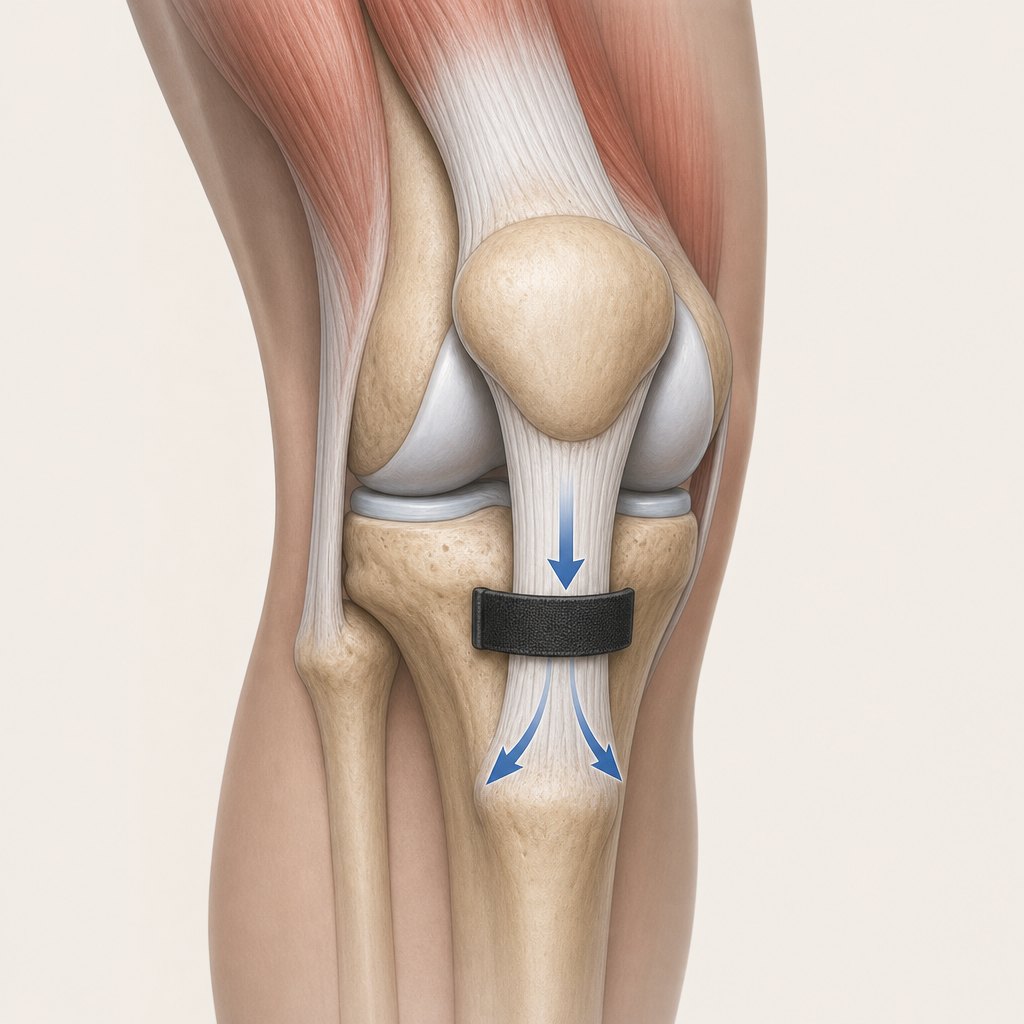
The strap sits on the patellar tendon, one inch below the kneecap — not around the joint.
It squeezes the whole joint evenly, from every direction at once. It feels supportive because it is tight, and tight is not the same as unloaded. The tendon under your kneecap is carrying exactly what it was carrying before you put it on.
It presses on one inch of the patellar tendon, an inch below the kneecap. That single contact point changes the angle the tendon pulls at, and moves load off the sore insertion and onto the band instead.
Here is the part nobody explains at the appointment.
Going down is worse than going up. Everybody who has this knows it and almost nobody knows why. On the way down, the muscle at the front of your thigh is not lifting you — it is paying you out, slowly, like a rope. All of that braking force runs through one cord: the patellar tendon, the band you can feel between your kneecap and your shin bone.
On a stair that load reaches many times your body weight, and it lands on the same small patch of tendon every single time. Decades of it leave the fibres at that one spot frayed and irritable. It is not the joint. It is one inch of cord below the joint, and it is the reason a step down hurts when a flat mile does not.
A strap changes where that load lands. Worn on the tendon it redirects up to 17 times body weight away from the inflamed point, and imaging puts the drop in tendon strain at around 34%. That is the whole idea, and it is the same principle the sports medicine clinics that treat this for a living have used on athletes for years.
Which is also why the drawer full of sleeves did nothing. They were never aimed at the tendon. They were aimed at the joint, and the joint was not the problem.
- Sits one inch below the kneecap
- Non-slip silicone grip
- One size, fully adjustable
- Invisible under jeans and leggings
- Stays put through a 12-hour shift
- Nothing to charge, nothing to replace
Six Weeks. Then I Booked The Bus.
She said she had not used her cane since March. They come two in a box, so she ordered me a pair that night, and she gave me an instruction with them.
“Wear it every morning. Then book yourself something. Somewhere she would never let you go on your own.”
Next morning I put it on and walked to the end of my road. Nothing happened. I stood at the corner feeling foolish.
Then I stepped down off the curb without thinking about it first.
Two years. Two years I had been thinking about it first. Every curb, every step, every time. You do not notice you are doing it until the morning you do not.
I wore it every morning for six weeks. Then I got the bus schedule out and I booked the Outer Banks trip. Three hundred miles. My name on the reservation and nobody else’s.
This is the strap she put on my kitchen table
Two Hundred And Fifty-Seven Steps
Cape Hatteras Lighthouse. Two hundred and fifty-seven steps, and a cast-iron staircase that turns and turns and turns.
At the top, two women about my age were getting their breath back at the rail.
One of them said, “Did you come up on your own?”
“I did.”
“So did we.”
Three hundred miles from my own kitchen, and I had not asked one person for one thing all day.
The woman next to me on the bus home had been a physical therapist. Thirty-one years of it. She watched me come down the step off the bus and she said something I have thought about since.
“Everything they send me is wrapped around the joint. That does nothing. Yours is in the right place.”
And then, quieter: “You don’t walk like somebody who’s managing it. You walk like somebody who’s forgotten about it.”

She Didn’t Say Sorry. I Didn’t Need Her To.
Nicole came over on the Sunday. She had seen the photographs.
“I didn’t think you’d manage the steps.”
“I know you didn’t, honey.”
She did not say sorry, and I did not need her to. She had not done anything wrong. She had watched her mother stop going places, and she drew the only conclusion anybody could draw from the outside.
She was right that I had stopped going out.
She was wrong about why.
The strap did not make me younger. It took the weight off one inch of tendon, and everything I had given up came back on its own — because it turned out I had not given any of it up for the reason everybody thought.
What Those Three Years Actually Cost Me
I added it up afterwards, which I do not recommend doing. Not one of these is expensive on its own. That is exactly how it gets to four thousand dollars without anybody noticing.
| The three years of managing it | What it cost |
|---|---|
| Rides to my son’s, $22 there and back, once a week for three years | $3,432 |
| Eleven braces and sleeves, still in the kitchen drawer | $340 |
| Two visits to the orthopedist | $150 |
| One cortisone shot | $180 |
| A cane I never liked and hardly used | $38 |
| What actually worked | One order, two in a box |
I Am Not The Only One Who Got Written Off Early

I have one on each knee for the garden. Three hours out there the day they came. My daughter thought I had hired somebody.

I wear mine under work pants for a twelve-hour shift and forget it is there. Nobody at work has ever noticed it, which mattered to me more than I would have admitted.

My son stopped asking me to hold the ladder. He never said why and I never asked him. Nine weeks after I started wearing this he asked me to help him do the gutters, and I have still not told him what changed.
Try It The Way Jean Told Me To
Wear it every morning. Then book the thing somebody else decided you were finished with. That is the whole test, and you have sixty days to send them back if I am wrong.
They come two in a box. Keep one, and give the other to somebody who has stopped coming to things.
See If Onepoint Is Still In StockDisclaimer: Mantle Onepoint is a patellar tendon strap — a wearable support garment. It is not a medical device and is not intended to diagnose, treat, cure or prevent any disease or condition, and it is not a substitute for medical care. Speak to a doctor about knee pain that is new, severe, follows an injury, or is getting worse. While the accounts on this page are real, they do not guarantee you will achieve a similar outcome. Individual results can and will vary.
Advertorial. The Knee Report is a publication of Mantle.
Copyright © 2026 The Knee Report. All Rights Reserved.