
7 Reasons The Eye Vitamins In Your Cupboard Never Reached Your Eyes
Number 4 is the one almost everybody over sixty has done, and it quietly cancels out most of what you paid for.
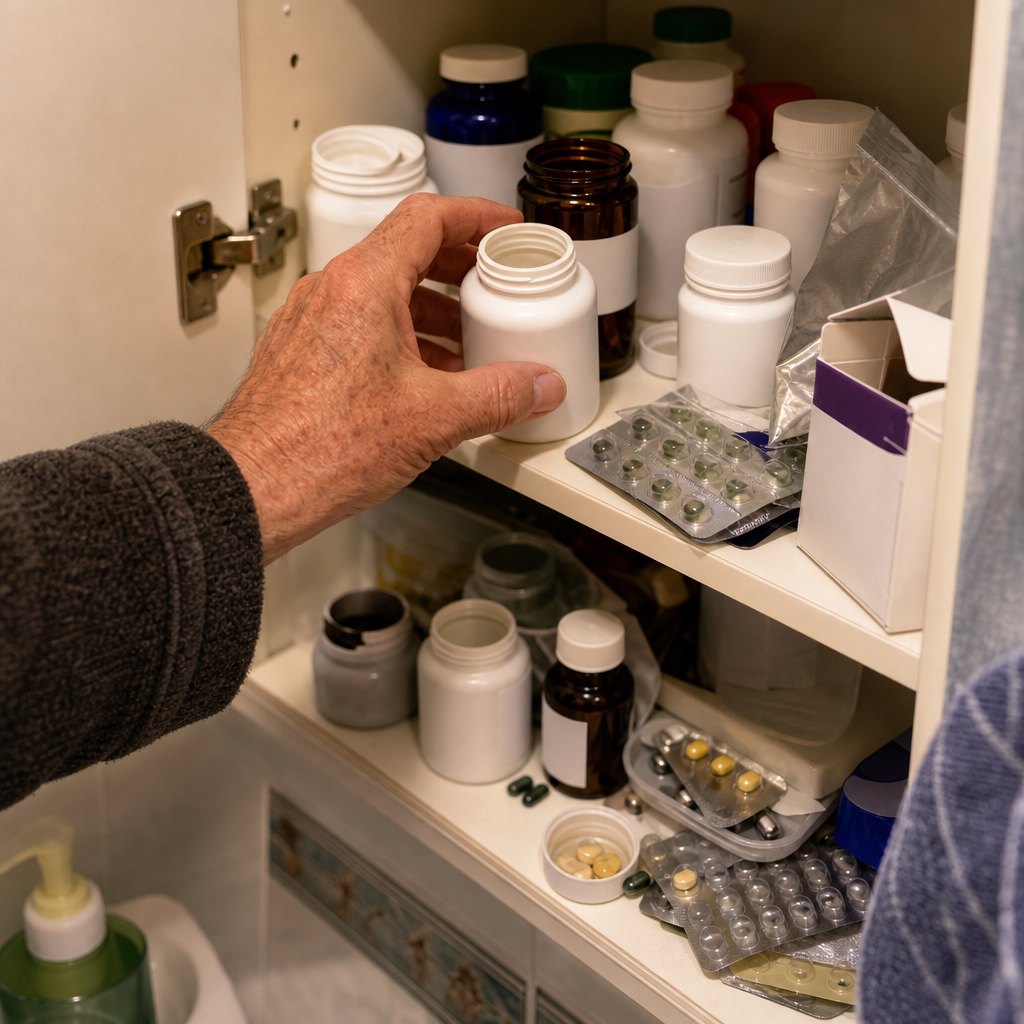

Roughly one in three adults over sixty has bought an eye supplement. Under one in ten has ever finished a bottle.
The usual explanation is that people are not consistent. That is not what the cupboards suggest. The cupboards suggest that people took them faithfully for two or three months, could not point to anything that had changed, and quietly stopped.
There are good reasons for that, and almost none of them are the ones you would expect. Most have nothing to do with the brand you bought.
You Take Them With Coffee And Toast
Lutein and zeaxanthin are fat-soluble. That is not a marketing word — it is a physical property, and it means they cannot be absorbed out of your gut unless there is fat in the meal they arrive with.
A slice of toast and a black coffee has effectively none. Cereal with skimmed milk has almost none. If that is your breakfast, and breakfast is when you take the capsule because that is when you remember, then a meaningful share of what you paid for goes straight through you.
You Bought It On The Milligram Number On The Front
The number on the front of the box is the amount that went into the capsule. It is an accurate number and it is honestly arrived at. It is also the least useful number on the packaging, because it tells you nothing whatsoever about how much arrives anywhere.
Two bottles can carry an identical 20 mg and deliver very different amounts, and a 40 mg bottle is not twice as good as a 20 mg one. Once you understand why — and number 7 is the why — the whole shelf starts to look different.
You Switched Brands Every Three Months
This is the most understandable mistake on the list and it is a genuinely expensive one.
Macular pigment is slow. It is not a painkiller and it is not caffeine — the honest published timeframe for any measurable change is months, not weeks. Three months on one bottle, three on another and three on a third is not three trials. It is one incomplete trial, run three times, on three products that all took the same route anyway.
You Take It Alongside A Multivitamin
This is number 4 and it is the one nearly everybody has done, usually on good advice.
Beta-carotene and lutein compete for the same absorption machinery in the gut. So do several other carotenoids. Take a big multivitamin containing beta-carotene at the same moment as your lutein capsule and they are, in a small but real way, in each other's way — you have paid for both and reduced what you get from one of them.
Nobody tells you this because nobody selling you the multivitamin has any reason to.
Before number 5 — if you have already done three of these, the rest of the article will make more sense once you know what is at the end of it.
See what it costsYou Assumed A Blood Test Would Show It Working
Serum lutein — the amount circulating in your blood — rises within days of starting a capsule. It is easy to measure and it looks like success.
The amount in the eye itself is a different measurement entirely, it takes months to shift, and in a significant number of people it barely shifts at all. The two numbers can point in completely opposite directions in the same person, which is why "it's definitely being absorbed" and "nothing has changed" are both true statements about the same bottle.
You Expected To Notice The Wrong Thing
People start an eye supplement watching for their sight to sharpen, because that is what an eye supplement sounds like it should do. Sharpness is a refraction problem and it belongs to your optician.
What actually changes first, when anything changes, is duller and much easier to miss: glare recovery — how long it takes your eyes to settle after headlights or a bright window — and the tiredness. Squinting all day is work, and you genuinely do not notice you are doing it until you stop.
Nobody Told You The Eye Has A Door — And That It Is Mostly Shut
Here is the one underneath all six of the others.
There is a barrier between your bloodstream and the back of your eye, and it is one of the tightest in the body — the same class of seal as the one around your brain. It exists to keep infection out of a tissue that cannot repair itself, and it does that job by keeping almost everything else out too.
So a swallowed capsule has to survive your stomach, find fat to be absorbed at all, get past the liver, ride the bloodstream past every other tissue that wants the same molecule — and then, last in the queue, arrive at a door that admits very little. Researchers have a name for the gap between what goes in and what gets there. Lutein Lockout.
It is why fixing 1 through 6 helps and does not solve it. Every one of those mistakes is about getting more lutein into your blood. None of them widens the door.
So What Do You Actually Do About It?
Fix the first six anyway. They are free, they take no effort, and they will get more out of whatever you are already taking.
But if you have done three months faithfully and have nothing to point to, the honest answer is that another capsule is unlikely to be the thing that changes it. There is only one way to get around a door, which is not to use it.
“Every few years somebody adds an ingredient to an eye capsule and calls it a breakthrough. The distance between the label and the retina is the one thing nobody was working on.”
Dr. Martin Vance, MD, ophthalmologist (28 years, retired)
The alternative to swallowing it is to put it on the outside of a closed eyelid — the thinnest skin on the human body — and let it in from a few millimetres away rather than from the far end of a digestive system.
The formula worth putting there is three things, not fifteen:
Luteora™
The two carotenoids the centre of your retina is physically built out of, and which your body cannot manufacture a single molecule of. Nothing controversial here and nothing new — this is the same pair that is in the bottle in your cupboard. The difference is not what it is. The difference is where it is put.
Veilpass™
This is the part a capsule has no equivalent of. Carotenoids are oily and the skin of the eyelid is the thinnest on the whole body, so the carrier is built to sit on that skin and stay there rather than bead up and run. The hyaluronic acid holds the film in place through a blink instead of letting it wick away in seconds.
Cyanthin™
Getting the pigment there is half a job if it is being oxidised the moment it lands. Bilberry and astaxanthin are the two the European work keeps returning to for glare recovery and for how fast an eye settles after a bright light, and vitamin E is the one that keeps the oil in the film from turning before it is used.
It is the same nutrient you already bought. It goes in a different way.
If you have three opened bottles in a cupboard, you have already run the experiment on the other route.