
“I Made Eye Vitamins For Twenty-Two Years. There Is A Number We Measured Every Single Batch And Never Printed On A Bottle.”
If you have taken an eye vitamin for a year and could not honestly say what changed, it was not your fault, you did not forget to take them, and it was never the lutein. Read this before you buy another bottle.

What I am about to write will not make me popular with the people I used to work for.
I am retired now. That is the only reason I can write it.
My name is Wesley Hart. For 22 years I was a formulation chemist for a contract manufacturer in the Midwest. You have almost certainly owned something I made. You will not have seen our name on it, because you never do — we made it, somebody else put their label on it, and it went on a shelf.
A great deal of what I made was eye vitamins.
I want to be careful here, because there is a version of this article that is cheap and I am not going to write it.
Nobody I worked with was a crook. The lutein in those capsules was real lutein at the milligram figure on the front of the box. We tested every batch and I signed off on a lot of them. If you have a bottle of eye vitamins in the cupboard right now, it almost certainly contains what it says it contains.
These are the things that crossed my bench, week in and week out, for two decades:
- Lutein and zeaxanthin capsules, 10 mg to 40 mg
- Softgels, tablets, gummies and powders of the same actives
- Own-label eye formulas for pharmacy chains
- Every reformulation, every dose increase, every relaunch
So here is the number.
We knew — everybody in that building knew — roughly how much of what we put in the capsule ever reached the part of the eye the box had a picture of. It was not a secret and it was not hidden. It simply was not our problem. Our job was to put the stated dose in the capsule and prove it was there. What happened after somebody swallowed it belonged to nobody.
And every year, when the results disappointed, the answer was the same answer it had been the year before. Put more in.
Let Me Guess What Happened To You
Your optician mentioned lutein. Not as a prescription — as a remark, on the way out, the way people mention a vitamin. So you bought a bottle.
You took it properly. Every morning, for three months, which is longer than most people manage. And at the end of three months you could not have told anybody what was different, so you assumed you needed a stronger one.
The next bottle was 20 mg instead of 10. Then somebody said the expensive brand was better, so you bought that. Then a gummy, because swallowing them was becoming a chore.
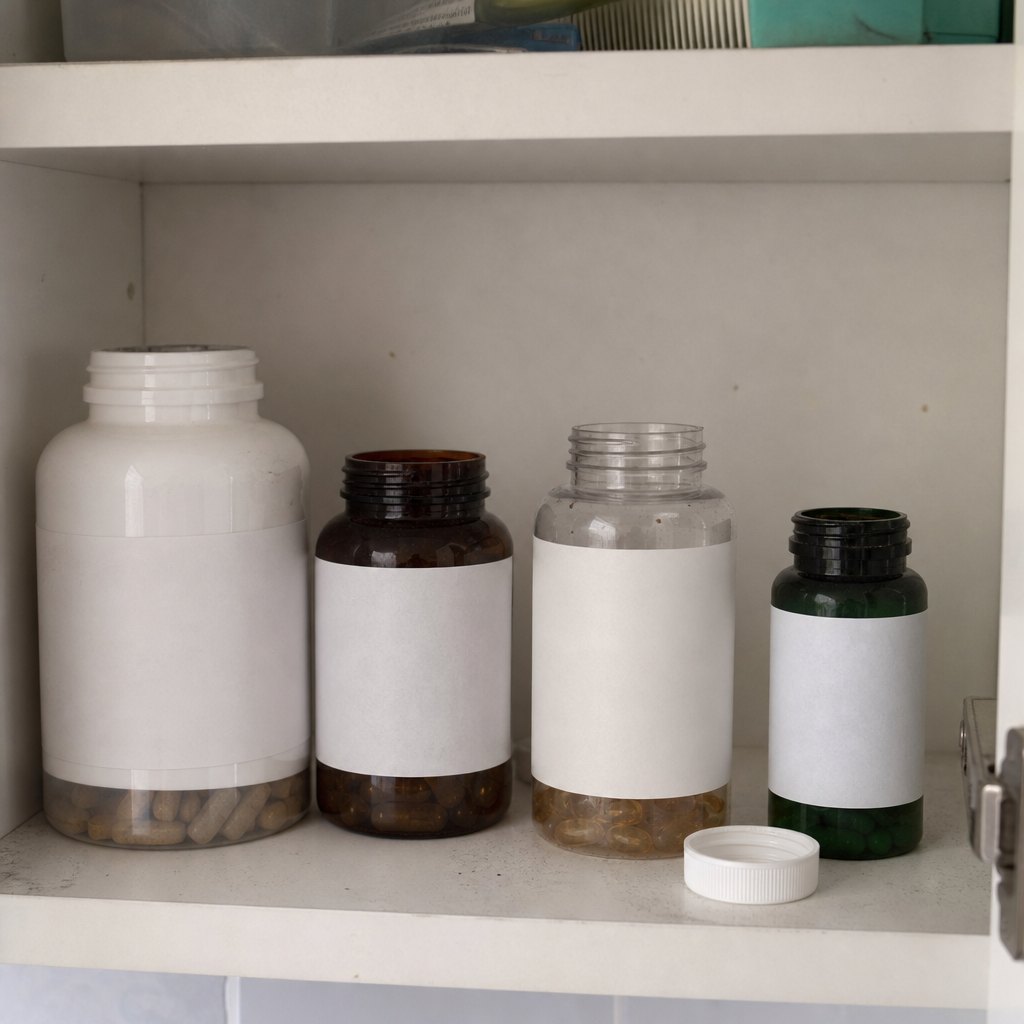
They are all still in there. All of them opened. None of them finished.
And somewhere in the middle of that you quietly decided the problem was you — that you had not been consistent enough, or that this is just what happens after sixty and you should stop wasting money on it.
You were consistent enough. You bought a good bottle. You took it correctly.
Your eyes were never short of lutein. Your lutein could not get in.
It’s Not The Dose. It’s Not The Brand. It’s Not That You Forgot.
There is a barrier between your bloodstream and the back of your eye, and it is one of the tightest in the human body — the same class of seal as the one around your brain. It is there on purpose. It keeps infection out of a tissue that cannot repair itself.
It also keeps almost everything else out.
So when you swallow a lutein capsule, this is the journey it takes. Down. Through the stomach, where it needs fat in the meal to be absorbed at all. What survives goes to the liver, which takes its cut and hands the rest to the bloodstream, which shares it out to every tissue that wants it — your fat, your skin, your liver again. And what is left, at the very end of that queue, arrives at a door that admits almost nothing.


This is the part that took me an embarrassingly long time to understand, and I am a chemist.
Blood levels of lutein go up within days of starting a capsule. You can measure it. It is genuinely absorbed and it genuinely circulates. That is the number the industry quotes, and it is a true number.
But blood is not the eye. The amount that reaches the eye itself moves slowly if it moves at all, and the gap between those two figures is the whole of this article. It is also the reason a bigger capsule does not fix it. Doubling what goes in the front does not widen the door at the end.
“We spent twenty years arguing about what to put in the capsule. Nobody in that building was working on whether it arrived.”
Wesley Hart, formulation chemist, 22 years
Go And Put Your Hand On The Radiator In The Furthest Room
Not now. When you finish reading. Go to whichever room in your house is furthest from the boiler — the spare room, usually, or whatever the coldest end of the hallway is — and put your hand flat on the radiator.
It will be lukewarm. It has been lukewarm for years.

Now: is your boiler broken? No. Is there not enough water in the system? No. Would a bigger boiler fix that radiator? Not really — you would heat the first six rooms harder and the seventh would still be the seventh.
The heat is real. The system is working. That room is simply last in the queue, and by the time anything reaches it there is very little left to give.
That is your macula, and that is every lutein capsule you have ever bought. The bottle is not lying to you. You are the room at the end of the hall.
Nobody Gives It Up All At Once
This is the part that made me write something rather than just retire quietly.
People do not lose their sight in one dramatic afternoon. They give things up, one at a time, over about a decade, and each individual surrender is so small that it never gets mentioned to anybody — including to themselves.
- The drive home after dark, which now needs planning, or a reason not to go
- The menu, handed across the table with a small joke about the lighting
- The chair by the window you used to read in, and now mostly sit in
- The evening class, given up over the parking rather than the class
- The face waving from the far side of the car park, waved back at blind
Not one of those is worth telephoning a doctor about. That is exactly why it goes on for ten years.
And the cruellest part is that a great many of those people did try. There are four bottles in the cupboard to prove they tried. They just tried the only thing anybody had ever offered them, which was to swallow more of something that was never getting there.
So What Would I Actually Do?
I would stop trying to solve it with a bigger number on the front of a box.
The only thing that changes the arithmetic is changing the route, and there is exactly one way to do that outside a clinic: put it on the outside of a closed eyelid, which is the thinnest skin on the human body, and let it go in from a few millimetres away instead of from the far end of a digestive system.
The formula I would want on that lid is not complicated, and it is not fifteen things. It is three:
Luteora™
The two carotenoids the centre of your retina is physically built out of, and which your body cannot manufacture a single molecule of. Nothing controversial here and nothing new — this is the same pair that is in the bottle in your cupboard. The difference is not what it is. The difference is where it is put.
Veilpass™
This is the part a capsule has no equivalent of. Carotenoids are oily and the skin of the eyelid is the thinnest on the whole body, so the carrier is built to sit on that skin and stay there rather than bead up and run. The hyaluronic acid holds the film in place through a blink instead of letting it wick away in seconds.
Cyanthin™
Getting the pigment there is half a job if it is being oxidised the moment it lands. Bilberry and astaxanthin are the two the European work keeps returning to for glare recovery and for how fast an eye settles after a bright light, and vitamin E is the one that keeps the oil in the film from turning before it is used.
That is ClearSight. It is not a better capsule and it does not pretend to be — it is the same nutrient, taken in through a different door.
I have no shares in it. I am sixty-one and I use it twice a day, which after twenty-two years of making the other thing is either an endorsement or a confession, and I have stopped trying to decide which.

If you have a cupboard with three or four opened bottles in it, you already know the thing this article is about. You have simply been told, every time, that the answer is another bottle.
Go and feel the radiator. Then decide.